

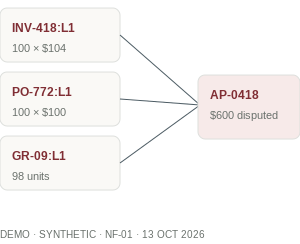
30 invoices. Matching evidence. One entity.
- 01
Confirm authority and scope.
Identify the data owner, selected exception workflow, entity, named reviewer and relevant policy. Establish permission, retention and handling before sharing a sample.
- 02
Remove sensitive identifiers.
Replace people, suppliers and entities with stable aliases. Remove bank details, tax identifiers, personal contact information and private document content that is not needed for the review.
- 03
Preserve the relationships.
Keep coherent pseudonymous invoice, PO, receipt and line IDs. Retain quantity, unit, unit price, totals, chronology and the links required to trace a comparison.
- 04
Make assumptions explicit.
Document tolerances, taxes, freight, discounts, returns, prior allocations and unit conversions where relevant. A reviewer should not need to guess the policy.
- 05
Keep ground truth separate.
Record the historical AP decision and reviewer time for later comparison. Blind review should not reveal the reference outcome to the person judging a new suggestion.
A practical data dictionary.
| Record | Fields to preserve | Handling note |
|---|---|---|
| Invoice | Alias IDs, dates, line quantity/unit/price/total | Remove real identities and payment details. |
| Purchase order | Linked PO/line ID, ordered units, authorized unit price | Keep the relationship to invoice lines. |
| Goods receipt | Linked receipt/line ID, received units, receipt date | Explain split receipts and allocations. |
| Policy | Policy version, tolerance and approval owner roles | State all comparison assumptions. |
| Vendor reference | Stable alias, prior-reference version and approval date | No real bank numbers or tax identifiers. |
| Historical review | Decision, reviewer role and elapsed review minutes | Keep separate for blind validation. |
Describe the sample before sharing it.
The first inquiry asks about readiness and permission. It does not ask for raw financial records.